Friday, November 26, 2010

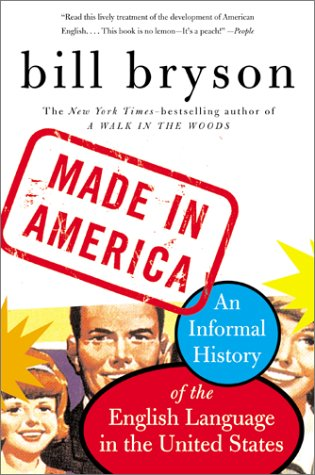
Made in America — Finished 2010.11.24


Began 2010.10.17; 
Secondary comment 2010.11.15.
☆☆☆☆☆
Much, MUCH, MUCH more than a history of the English language in America! Bryson with magical and funny writing links the evolution of language with the evolution of culture, science, recreation, food, politics. His controversial or almost heretical debunkings of accepted history are supported with an extensive bibliography of the sources.

The debunking is endless! Barely a page was turned that didn't leave me amazed at how much I don't know, and just how far away from documented history is the accepted and taught history of just about every aspect of the Europeans' settlement of the 'new' world. About the only thing somewhat factually correct about the white man's settlement of North America is that Europeans came and decimated and displaced the natives. As an example, one of the unknown reasons that the Natives were able to help the first American settlers was that one of them spoke very good English. That synopsis does Bryson's writing a severe injustice, so here is his (slightly abbreviated) telling:

... Before long, as every [American] schoolchild knows, the Pilgrims were thriving, and Indians and settlers were sitting down to a cordial Thanksgiving feast. Life was grand.

A question that naturally arises is
how they managed this. Algonquian, the language of the eastern tribes, is an extraordinarily complex and agglomerative tongue... full of formidable consonant clusters that are all but unpronounceable by the untutored...

...The answer, surprisingly glossed over by most history books, is that the Pilgrims didn't have to learn Algonquian for the happy and convenient reason that Samoset and Squanto spoke English — Samoset only a litte, but Squanto with total assurance (and some Spanish into the bargain.)
(4)
I also learned that the so-called Christian purity that, amongst other things, has been accused of distorting American English into using euphemism in place of body part words, originally spoke sexually explicit language enough to make fans of Playboy blush. And, even more astonishing, that the Puritans actively encouraged premarital sex in the 18th century as an accepted method of testing physical compatibility.
Sex among the Puritans was considered as natural as eating, and was discussed about as casually, to the extent that, the historian David Fischer writes, 'the writings of the Puritans required heavy editing before they were thought fit to print even in the mid-twentieth century.' Premarital intercourse was not just tolerated but was effectively encouraged. Couples who intended to marry could take out something called a pre-contract — in effect, a license to have sex. It was the Puritans, too, who refined the intriguing custom of bundling, or tarrying as it was also often called, in which a courting pair were invited to climb into bed together...

As one seventeenth-century observer explained it: 'When a man is enamoured of a young women, and wishes to marry her, he proposes the affair to her parents; if they have no objections they allow him to tarry the night with her, in order to make his court with her. After the young ones have sat up as long as they think proper, they get into bed together, also without pulling of their undergarments in order to prevent scandal. If the parties agree it is all very well; the banns are published and they are married without delay. If not they part, and possibly never see each other again; unless, which is an accident that seldom happens, the forsaken fair proves pregnant, and then the man is obliged to marry her.'

...Although never expressly countenanced, fornication was so common in Puritan New England that at least one parish had forms printed up in which the guilty parties could confess by filling in their names and paying a small fine... "
(305-6).
Bryson defrocks most of Kroc's reputed claims to fame, critically examines myths around the evils of immigrants, suggests that one of the best living examples of how 'real' English may have been spoken is to listen to Yosemite Sam, points out that the famous 'That's one small step for man, one giant leap for mankind' was in fact the miss-heard version of 'That's one small step for a man, one giant leap for mankind.' Bryson also wades into the issue of politically correct language with intelligence, diplomacy, and razor sharp observations — and, of course, humour.

This books re-affirms the vivifying joy and beauty and aliveness of the English language. A gem of a book, and one I will now go out and buy.
  

Monday, November 15, 2010

Made in America — Continues with Economic Lessons — 2010.11.15

I am continuing to thoroughly enjoy Bryson's Made in America. He demonstrates in a way that words cannot convey, that language, in this case the English language, is alive like a giant garden — the masters of English are constantly weeding, trimming, hedging, and 'improving' the garden, but Nature is constantly adding to it in the wild untamed corners, poking weeds and shrubs into the garden, especially its edges, with wanton abandon and joy.

And in his typical fashion, Bryson makes comments about society as he is examining of the evolution of the society's language and words. I am putting together an 3-day economics course for my local Continuing Education programme. Shortly after receiving confirmation of the course approval, I read the following, which I'll be incorporating into my course and/or reading materials:

The dropping of atomic bombs on Hiroshima and Nagasaki marked the end of one war and the beginning of another: the cold war. The cold may not have generated a lot of casualties, but it was nonetheless the longest and costliest war America has ever fought. War was unquestionably good for business — so good that in 1946 the president of General Electric went so far as to call for a 'permanent war economy.' he more or less got his wish. Throughout the 1950s, America spent more on defense than it did on anything else — indeed, almost as much as it did on all things together. By 1960, military spending accounted for 49.7 percent of the federal budget — more than the combined national budgets of Britain, France, West Germany, and Italy. Even America's foreign aid was overwhelmingly military. Of the $50 billion that America distributed in aid in the 1950s, 90 percent was for military purposes ( p300-1).

I am building a web page this course, which I've called Economics Demystified. [At the time of this blog, the web page is still under construction, and will be for a month or two more.] Anyway, within Economics Demystified I have created a page called 'Found Economics.' And I am including the above as my first example of a non-economist commenting on economics outside of a formal economic context.

Thursday, October 28, 2010

Made in America: An Informal History of the English Language in the United States — Begun 2010.10.17

After finishing Bryson's Shakespeare: The World as a Stage a couple of weeks ago, and loving it; and after having been blown away by his The Life and Times of the Thunderbolt Kid; my friend BV clomped into work with two more Bryson books — In a Sunburned Country and
Bill Bryson.
Made in America: An Informal History of the English Language in the United States.
New York: Perennial (HarperCollins), 2001.


Of the two I chose this one first for two reasons. What better book to follow up on his Shakespeare book and Mair's Tao Te Ching with its fascinating etymological journey. The second reason is my enjoyment of the English language, its uses, abuses, creativity, and pure 'dance-ability.'

I'm on page 190 300 or so, as I write this, and it is brilliant! And not just because it is an engaging, interesting, entertaining and humorous history, but because of the ostensibly heretical history Bryson seamlessly incorporates into the narrative. I love learning that everything, and mean EVERYTHING I was taught or have learned about the history of the European's entry into the Americas is wrong. Okay, okay, so Europeans settled here and effectively wiped out the aboriginals in one way or the other — but that is pretty much the sum total what has at least a grain of historical truth from my schooling both formal and informal.


And, very amusingly, it has provided, to date, two amusing fushigis, or synchronicity-petites; the first about the train porters of American all being called George; and now about 'jerk' chicken.


☆ ☆ ☆ ☆ ☆


And what makes this, my reading Bryson from book's borrowed from BV, is that back in 2003-4 BV pestered me about reading Bryson!

Thursday, October 14, 2010

Tao Te Ching: The Classic Book of Integrity and the Way &mdash Finished 2010.10.12

Lao Tzu (老子).
Tao Te Ching: The Classic Book of Integrity and the Way.
Translated with an introduction by Victor H. Mair.
Toronto: Bantam Books, 1990. ISBN 055334935X.
☆ ☆ ☆ ☆ ☆

This book is in every way a delightful read! The translation is excellent to read in English — but given my lack of ancient Chinese language skills, I'll trust the experts who claim the actual translation to be excellent.

I had very high expectations for this book because Mair's translation and commentary to Chuang Tzu's Wandering on the Way: Early Taoist Tales and Parables of Chuang Tzu is one of the books in my top ten all time favourites. Well, the Tao Te Ching translated by Mair has snuggle up to it, and surpassed the half dozen other respected translations of it I've read.

But it isn't just the translation that makes this book so good. It is the level of scholarship in the common language threads linked etymologically between ancient Chinese, Sanskrit, the Indo-European languages, and old English. Mair does an extensive look at the cognates of Tao, Te and Ching. The information is fascinating, and completely extirpates the idea that China was isolated from the world in the development of its philosophy.

Mair also draws attention to many parallels extant between the Tao Te Ching and the Bhagavad Ghita. This discussion is equally fascinating and, for me, timely, given that I have been recently reading and re-reading the Bhagavad Ghita. His observations are well founded.

Anyway, Mair's examination of Tao, pronounced 'dow', is worth sharing, at least in part. So, from Mair's appendix, 'The Way/Tao:'

... The archaic pronunciation of Tao sounded approximately like drog or dorg. This links it to the Proto-Indo-European root drogh (to run along) and Indo-European dhorgh (way, movement). Related words in a few modern Indo-European languages are Russian doroga (way, road), Polish droga (way, road), Czech draha (way, track), Serbo-Croation draga ([path through a] valley), and Norwegian dialect drog (trail of animals; valley). The latter two examples help to account for the frequent and memorable valley imagery of the Tao Te Ching; ways and valleys, it would appear, are bound together in our consciousness.
The nearest Sanskrit (Old Indian) cognates to Tao (drog are dhrajas (course, motion) and dhraj (course). The most closely related English words are 'track' and 'trek,' while 'trail' and 'tract' are derived from other cognate Indo-European roots. Following the Way, then, is like going on a cosmic trek. Even more unexpected than the panoply of Into-European cognates for Tao (drog) is the Hebrew root d-r-g for the same word and Arabic t-r-q, which yields words meaning 'track, path, way, way of doing things' and is important in Islamic philosophical discourse (132).
The world, it would seem, has been a small place for a long time.


Sunday, October 10, 2010

Shakespeare: The World as a Stage — Finished 2010.10.07


A delightful, funny, shocking, interesting, learned and wonderful read. I found particularly amusing the final chapter, in which Bryson de-bunks the Shakespeare debunkers — which have included Orson Wells, Derek Jacobi, Sigmund Freud, Mark Twain, and more than a few others despite an overwhelming lack of evidence or even clear arguments.

Anyway, here is a nice sample of Bryson's writing from that final chapter:
... in 1918 a schoolmaster from Gateshead, in north-east England, with the inescapably noteworthy name of J. Thomas Looney, put the finishing touches to his life's work, a book called Shakespeare Identified, in which he proved to his own satisfaction that the actual author of Shakespeare was the seventeenth Earl of Oxford, one Edward de Vere. It took him two years to find a publisher willing to publish the book under his own name. Looney steadfastly refused to adopt a pseudonym, arguing, perhaps just a touch desperately, that his name had nothing to do with insanity and was in fact pronounced loney. (Interestingly, Looney was not alone in having a mirthful surname. As Samuel Schoenbaum once noted with clear pleasure, other prominent anti-Stratfordians of the time included Sherwood E. Silliman and George M. Battey (p186).)

Bryson describes how this whole anti-Stratford movement appears to have gotten started by an unstable  American woman with the surname Bacon and charm enough to get money to travel to England and for an extended multi-year period, do research without talking to people. The trip proved to her mind that Francis Bacon was the author, although she did not actual state that in her book but rather inferred it.

Reading this is very amusing! The more so because a few years ago one of my co-workers dropped off some documents that contained links to proofs that Shakespeare's words were the work of someone else. But of course they didn't actually prove anything. JB found it amusing to try to stir me up, given my organizing annually for my work mates a group trip to our local Shakespeare festival. Anyway, he made the argument that '... historically it doesn't make sense that Shakespeare wrote what he did' he argued in similar vein to all anti-Stratfordians. (I think it a weak argument, but it would seem that others like it.)

'So, JB,' I asked him, 'have you read any Bacon or Marlowe?' These were the two with intellect and education enough to be the 'real' Shakespeare in his research.

'No,' he said, 'I'm looking at this strictly from an historical perspective.'

'Well, JB,' I responded, 'I have read both those writers — and they did not write the words that the world ascribes to Shakespeare. Bacon's writing is pontifical dreck and Marlowe's is black and lacking the depth of human understanding you get from Shakespeare.'

Paul Budra, Professor of English @ SFU,  was asked to express his opinion on the matter  at a well attended lecture at Vancouver's Bard-on-the-Beach Shakespeare festival a few years ago. (The tone of the querent suggested that he was one of the anti-Stratfordians.) Prof. Budra's answer was short and to the point: 'I am open to that possibility. However, there is not one single piece of evidence in existence, not even a tiny one despite years of painstaking research, that would indicate that anyone else wrote these plays. On the other hand, there is a great deal of direct evidence that he did.'

☆ ☆ ☆ ☆ ☆
Bill Bryson.Shakespeare: The World as a Stage. London, GB: Harper Perennial 2008. ISBN: 000719790X.

Saturday, October 9, 2010

Noam Chomsky Lectures: A Play — Finished 2010.09.30

A delightful introduction to the degree to which the corporate news media disseminates dis-information. And it is a fun reminder of the importance of Chomsky in providing a voice against the agents who are manufacturing consent.


I also was inspired by how the writers morphed theatre into an entertaining lecture hall! Or did they morph a lecture into theatre?! This is what great instructors do naturally, of course, but who are very rare. Well, in this little play that could, Brooks and Verdecchia proved themselves great instructors — and better than passable dramatists.


Daniel Brooks, Guillermo Verdecchia.
The Noam Chomsky Lectures.  Toronto: Coach House Press, 1991. ISBN 0889104131.


☆ ☆ ☆ ☆ ☆

Friday, September 24, 2010

The Lazy Man's Guide to Enlightenment — Finished 2010.09.22

My friend RT gave me a copy of this book. I admit that I do not remember either hearing or seeing anything about this book before the day RT presented me with it last week. This is, to my mind rather odd given the range of so-called 'spiritual' books I have read and researched in the last 35 years or so. And I frequent the bibliography section of those books that have them, and don't remember having my eye or my mind's eye catch it.


Thaddeus Golas.
The Lazy Man's Guide to Enlightenment.
Palo Alto, CA.: The Seed Center, 1974.


And in the laziness theme of the book, here is the short review I gave it in my on-line library, GoodReads.
I have an ambivalent reaction to this book. It gave me no new understanding, but I like that Golas has aligned himself with Chuang Tzu and like Taoists who argue against straining and struggling to take actions or achieve understanding. It is likely at a more challenging level to spiritual than an introduction, but unnecessary for people who I have been struggling with the spiritual meanings of life. I quite like his blunt way of stating the obvious truths we delude ourselves into not seeing. As such I keep thinking that it deserves more than 3 stars, but I cannot bring myself to move my rating to 4. Perhaps my concern about it is that like many spiritual guides, it emphasizes the role of mind and attitude in achieving so-called enlightenment at the expense of respecting one's somatic reality, and perhaps well-being. As a society we are completely beholden to products of the mind, be it agri-business's justified land, water and animal abuse, the poisoning of our food products with -icides or business practices with Harvard Business Schooled flow-charted MBA-itis. 
To extend that a bit, I also found that, while what Golas has written is truthful and will likely lead to enlightenment, it seemed to lack some kind of hard to isolate substantiveness. I found myself left feeling a little ... disappointed, somehow, even though it participated in a curious fushigi (or synchronicity-petite) while I was reading it.

I admit that my reaction is very likely a sign that I am indeed un-enlightened. And that is undoubtedly true. But I guess I have grown to enjoy the weight of Jung's and Berman's writing, and the light complexity of Chuang Tzu and the like. Have I become addicted to good writing, at the expense of moving towards enlightenment? Hmmmmm.

☆ ☆ ☆